

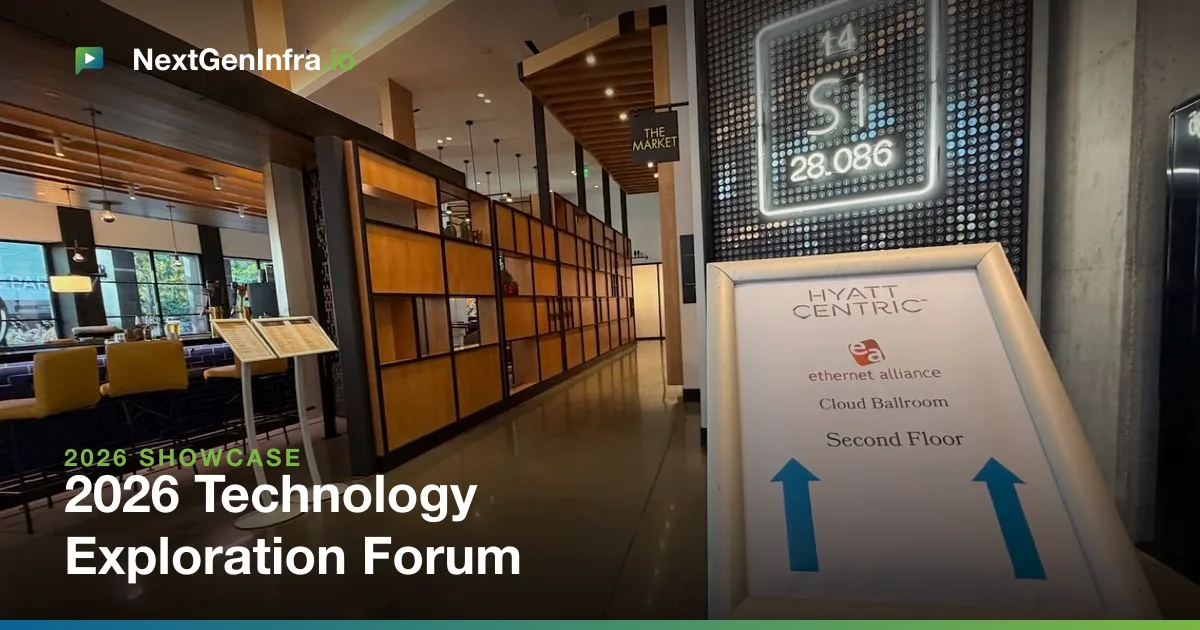
Technology Exploration Forum Showcase
While you're here, feel free to grab our latest research brief right from this page.
How 400G Electrical Unlocks $1 Trillion AI Network Market This Decade
AI Drives Faster Ethernet Adoption: 200G/Lane Now, 400G/Lane by 2028
Solving 100G Signaling: Modulation, Power & Channel Reach Trade-offs
Coherent Optics Inside Data Centers
448G per Lane: Power, Loss, and Co-Design
Micro-VCSEL Arrays for AI Scale-Up Networks
Key Take Aways from Ethernet Alliance's Technology Exploration Forum 2026
AI Ethernet Infrastructure: Scaling to 400G and Beyond for Hyperscalers
Ethernet Physical Layer Specs: FRO, LRO & LPO Update
AI Ethernet at 448G per Lane: Measurement Science Advances
Making 400G Optical Networks AI-Ready: Challenges and Solutions
AI Data Centers Need 400G Coherent Optics Beyond 2Km
Power, Cooling & Fiber Optic Challenges
Optics Will Enable Massive GPU Interconnection
IEEE 802.3dv: 400G Ethernet Standards for AI & Front-End Networks
Solving 448 Gbps per Lane Challenges
Scaling AI Networks: UEC and UALink
New Protocols, Lower Latency & Testing Challenges
AI's 4 Major Challenges to Ethernet Standards in Data Centers
Faster Speeds, Shorter Cycles, Massive Scale
Latest Research Brief
Download Our Latest Report
Data Center Networking in 2026 — Scaling to New Heights
More about this report →
No personal info needed to download
By downloading this report, you agree to our Terms of Use and Privacy Policy.
What we learned at TEF 2026
Interviews from the Ethernet Alliance's Mountain View forum agree that AI is no longer just adopting Ethernet but setting its pace, pulling 400G per lane, coherent optics, and scale-up into a two-year cycle.
1.6T is nearly done; 3.2T is the new target
The Ethernet Alliance expects 802.3dj to be ratified by OFC, though cost per gigabit is still high, and TEF's focus has moved on to 3.2T. 650 Group calls 400G electrical lanes in 400×8 configurations the key to getting there. Arista sees 200G per lane shipping now and 400G per lane in labs by 2028.
Generations now turn over in two years, not seven
VIAVI traces the speed cadence from seven years in the telecom era to four with hyperscalers and two with AI. Terahop adds that products must be deployment-ready on day one, at volumes of hundreds of millions of optical units. 650 Group sees ports growing tenfold and Ethernet switching passing $300B this decade on its way to $1T.
At 400G per lane, no single modulation wins
Broadcom matches PAM6 to passive copper and backplanes and PAM4 to active cables. IEEE 802.3dv, chaired by Synopsys' Kent Lusted, is converging on PAM4 for optics while defining both electrical options. Microsoft wants to avoid PAM6-to-PAM4 gearboxing, and Keysight expects 100–250 GHz measurement work to settle the choice within ten months.
Coherent optics moves inside the data center
OIF says IM-DD tops out around 2 km at 400G, short of what AI campuses with optical switches need, and is launching a 1600 Coherent-Lite project. Ciena says the question is no longer whether to use coherent but which kind: 1600ZR-class DSPs or lower-power, Ethernet-optimized designs, with IEEE decisions starting in 2027.
Optics heads for scale-up
Panduit expects optics to grow scale-up domains from 72 GPUs to tens of thousands acting as one. Eliyan proposes smartphone-derived micro-pixel arrays to get past the copper wall. The Ethernet Alliance weighs NPO, CPO, and XPO packaging and tracks retimed, half-retimed, and linear pluggable optics, while CommScope questions whether DSP-less linear optics will hold up at 400G.
Power, fiber, and testing get harder
Panduit sees liquid cooling and eight-plus network planes multiplying fiber counts, and CommScope answers tight loss budgets with low-loss V-groove and self-cleaning connectors. Teledyne shows UEC for scale-out and UALink for scale-up, with LLR and CBFC lengthening test cycles. The Ethernet Alliance is preparing a special 2027 roadmap on Ethernet for AI.
Highlights from industry thought leaders
















Video interviews
How 400G Electrical Unlocks $1 Trillion AI Network Market This Decade
- 400G electrical signaling is the key enabler for 3.2 terabit Ethernet in 400×8 configurations.
- Ethernet entering scale-up, alongside scale-out and scale-across, pushes switching past $300 billion this decade and toward $1 trillion early next decade.
- Ports grow from tens of millions to hundreds of millions, demanding an order-of-magnitude jump in manufacturing capacity.
Abstract
AI Drives Faster Ethernet Adoption: 200G/Lane Now, 400G/Lane by 2028
- AI is making each Ethernet generation ramp to high volume much faster than before.
- 200G-per-lane products begin shipping in Q4 with higher volumes next year, and 400G per lane is expected in lab testing by 2028.
- The Ethernet Alliance speeds IEEE consensus on 400G-per-lane standards and runs early multi-vendor plugfests for interoperability.
Abstract
Solving 100G Signaling: Modulation, Power & Channel Reach Trade-offs
- Modulation, channel reach, and power together form the hardest problem as lane rates double from 200G to 400G.
- No single modulation fits every topology — PAM6 suits passive copper and backplanes, PAM4 suits active cables.
- Long reaches need AEC, ACC, or linear optics, and solving 400G calls for a holistic, industry-wide systems approach.
Abstract
Coherent Optics Inside Data Centers
- Coherent optics is finally moving inside the data center with 1.6 terabit Ethernet.
- AI shifts priorities from cost-per-bit to power, latency, and loss budgets, with optical circuit switches driving higher loss.
- The debate is now which coherent — 1600ZR-class DSPs or lower-power, Ethernet-optimized designs — with IEEE decisions starting in 2027.
Abstract
448G per Lane: Power, Loss, and Co-Design
- Power is the top concern at 400G, and it is unclear whether DSP-less linear optics will still work at that rate.
- Tight optical loss budgets make low-loss, high-density, reliable fiber connectivity essential, co-designed with racks, power, and networking.
- CommScope is developing V-groove connectors and fast self-cleaning connector technology for AI networks.
Abstract
Micro-VCSEL Arrays for AI Scale-Up Networks
- Copper dominates scale-up networks today but can't meet their growing reach requirements.
- Micro-pixel arrays pack 200 pixels into a square millimeter, with redundancy that boosts reliability.
- Reusing smartphone face-recognition components keeps the approach widely available and low cost.
Abstract
Key Take Aways from Ethernet Alliance's Technology Exploration Forum 2026
- The 1.6 terabit Ethernet specification (802.3dj) is nearly complete and expected to be ratified by OFC.
- The 1.6T ecosystem is maturing fast with strong test, measurement, and interconnect participation, though cost per gigabit remains high.
- TEF focused on the path to 3.2 terabit Ethernet, building on 1.6T work with input from hyperscalers and manufacturers.
Abstract
AI Ethernet Infrastructure: Scaling to 400G and Beyond for Hyperscalers
- TEF 2026 tackled 400 Gb/s copper and the cabling burden of AI campuses with millions of cables between buildings.
- Optics options span IM-DD and coherent, packaged as NPO, CPO, or the emerging XPO form factor — with testability a challenge that needs early attention.
- The Ethernet Alliance is preparing a special 2027 roadmap edition focused on Ethernet for AI.
Abstract
Ethernet Physical Layer Specs: FRO, LRO & LPO Update
- The Ethernet Alliance tracks three optical families: fully retimed (FRO), linear receive (LRO/RTLR), and linear pluggable (LPO).
- Specs from IEEE 802.3 and OIF are evolving as the industry shifts from 100G to 200G per lane.
- Alliance reference tables help the community see which host-side solution each application needs.
Abstract
AI Ethernet at 448G per Lane: Measurement Science Advances
- Channel and connector limits make the modulation choice for 400 Gbps the central open question.
- Keysight is building VNAs, oscilloscopes, and test tools for the 100–250 GHz range, along with tools to characterize dielectric materials.
- Measurement science will shape modulation decisions over the next ten months, with 800 Gbps signaling already in view.
Abstract
Making 400G Optical Networks AI-Ready: Challenges and Solutions
- Link flaps, modulation issues, and form factors with poor serviceability hold back AI-ready 400G optics.
- Vendors need stronger screening and quality control so the burden doesn't fall on hyperscalers and customers.
- Microsoft prefers NRZ or PAM4 for optics, since gearboxing from PAM6 to PAM4 adds interoperability, latency, and power penalties.
Abstract
AI Data Centers Need 400G Coherent Optics Beyond 2Km
- At 400G, IM-DD optics max out around 2 km — short of what hyperscale AI campuses need.
- Coherent optics are likely the only viable option at 2 km and beyond, with room for added loss from connectors and optical switches.
- OIF's new 1600 Coherent-Lite project and IEEE's planned coherent work call for close coordination to avoid duplication.
Abstract
Power, Cooling & Fiber Optic Challenges
- Power constraints are pushing AI systems from air to liquid cooling.
- Higher data rates and multi-plane architectures of eight planes or more demand far more fiber infrastructure.
- Panduit focuses on foolproof, future-proof, and faster-to-deploy solutions to speed cloud providers' time to revenue.
Abstract
Optics Will Enable Massive GPU Interconnection
- Optics in scale-up architectures will be the biggest surprise of the next five years.
- Growing AI models need low latency and high bandwidth across ever-larger scale-up domains.
- Ethernet-based optics will take scale-up from 72 to 144, then 500, and eventually tens of thousands of GPUs acting as one.
Abstract
IEEE 802.3dv: 400G Ethernet Standards for AI & Front-End Networks
- IEEE 802.3dv is defining 400G-per-lane signaling for backplanes, copper cables, and 500-meter optical reaches.
- The task force has strong consensus on reusing the existing logic architecture and converging on PAM4 for optics.
- Defining both PAM4 and PAM6 electrical specs leaves room for linear, half-retimed, co-packaged, and near-packaged designs.
Abstract
Solving 448 Gbps per Lane Challenges
- AI demand forces bandwidth, density, modulation, and power to be solved at the same time.
- 448 Gbps per lane, nearly unthinkable two years ago, now has PAM4 and PAM6 prototypes — passive for short reach, active or optical for longer.
- Data centers will look very different in five years, with new architectures, cooling, and power.
Abstract
Scaling AI Networks: UEC and UALink
- Ethernet is evolving through Ultra Ethernet (UEC) and UALink to meet AI workload demands.
- UEC addresses scale-out, while UALink provides scale-up.
- CBFC demonstrations show how traffic prioritization shapes future AI network architectures.
Abstract
New Protocols, Lower Latency & Testing Challenges
- AI needs more than speed — it demands lossless fabrics and much lower latency.
- New protocols such as UALink, LLR, and CBFC add complexity to Ethernet designs.
- Development and test cycles for AI products are longer and more complicated, so testing needs more focus before launch.
Abstract
AI's 4 Major Challenges to Ethernet Standards in Data Centers
- AI generations now turn over in 1–2 years, versus the traditional 4–5 year Ethernet cycle.
- AI data centers need mature, deployment-ready products immediately, at volumes of hundreds of millions of optical units.
- Scale-up, scale-out, scale-across, and scale-in requirements add complexity to Ethernet standardization.
Abstract
Faster Speeds, Shorter Cycles, Massive Scale
- The cadence between Ethernet speeds has shrunk from seven years in the telecom era to four with hyperscalers, and now two with AI.
- AI scale jumps from thousands to millions of connections, requiring dozens of factories and production lines.
- The ecosystem is positioned to reach 400 gigabit per lane and the gigascale data center era despite the compressed timelines.
Abstract
By downloading this report, you agree to our Terms of Use and Privacy Policy.
Continue exploring
More executive showcases across next-gen infrastructure.
2025 OCP Global Summit
Exclusive videos from thought leaders covering data center networking (scale-up, scale-out, scale-across), photonics, liquid cooling, SONiC
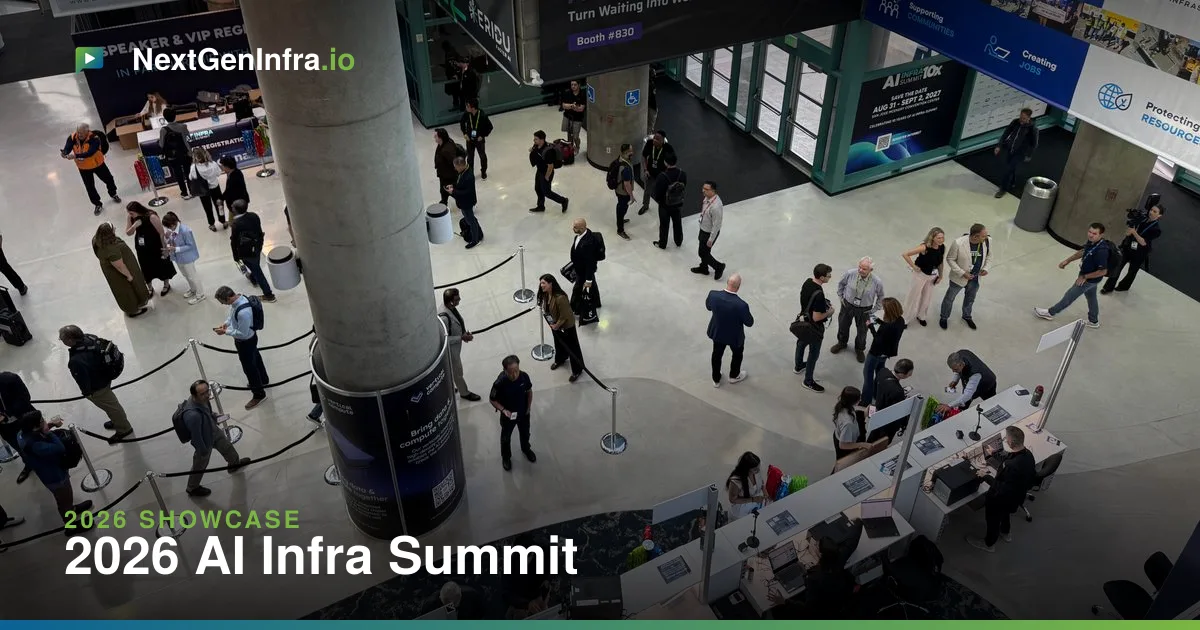
2026 AI Infra Summit
Executives at AI Infra Summit 2026 in Santa Clara discuss full-stack AI infrastructure — chips, interconnects, networking, memory, storage, power, and the data centers behind AI training and inference
2026 Data Center Networking
Infrastructure leaders discuss data center networking and impact of AI/GenAI. Topics: InfiniBand, UEC, NVLink, UALink, ESUN